
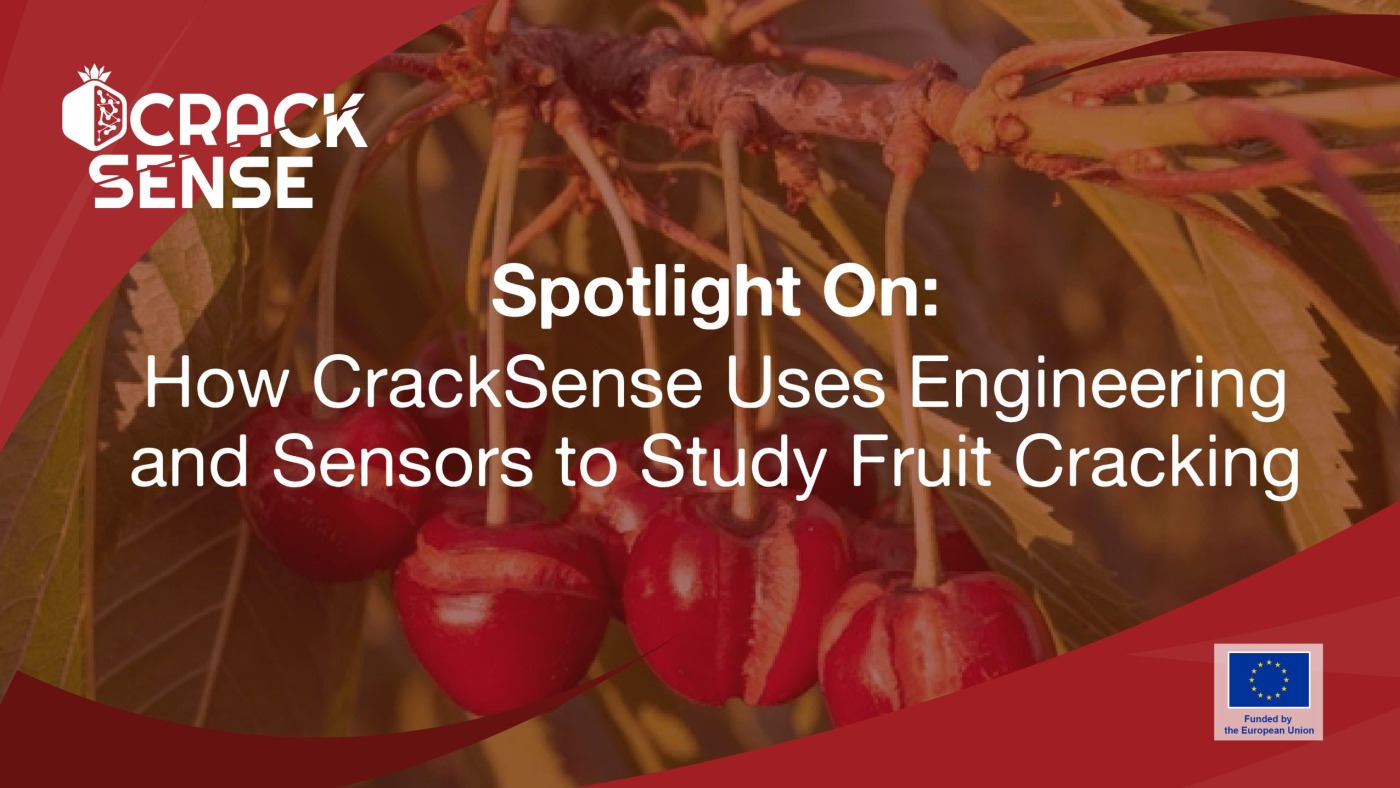
In this feature of our Spotlight series, Dr. Nicolas Tapia Zapata, Researcher in Precision Horticulture at The Leibniz Institute of Agricultural Engineering and Bioeconomy (ATB) and partner in the CrackSense project, discusses his work on understanding fruit cracking mechanisms through an engineering lens.
By integrating sensing technologies with mathematical analysis, he investigates the mechanical engineering factors that contribute to fruit cracking. Discover how precision horticulture is opening new avenues for mitigating fruit cracking in various crops.
Bringing Engineering into the Orchard
Could you please introduce yourself and provide an overview of your research and the work of your organisation?
My name is Nicolas Tapia Zapata. I am a postdoc at the Leibniz Institute for Agricultural Engineering and Bioeconomy in Germany, in Potsdam. I am part of the Precision Multiculture working group, and my area of expertise is to investigate the mathematical and physical properties of fruit. In the context of CrackSense, my role is to bring these sensing technologies and knowledge into the field to investigate the cracking problem in more detail.
Which technologies do you use, and how do they help explain fruit cracking?
Traditionally, orchard management has focused more on agronomical practices, meaning it involves mainly physiological and biological processes. At the ATB Institute, however, we always try to integrate engineering more closely with physiology. For this reason, we work extensively with sensing technologies. More specifically, we design our own arrays with different sensors and use sensor fusion for later inspection of crop behaviour using computer analysis.
For example, we combine LiDAR and thermal technologies in order to obtain information about both the geometry and the thermal behaviour of crops. This allows us to better understand the microclimate, which is very complex and difficult to capture in real orchard conditions. This is our starting point: we first collect data, and then we try to better understand the dynamics within the microclimate in order to decipher what cracking actually is from an engineering point of view.
Conclusion
Understanding fruit cracking from an engineering perspective requires combining advanced sensing technologies with insights into plant physiology, allowing for a more detailed analysis of crop behaviour under real orchard conditions. By integrating data on microclimate, geometry, and thermal dynamics, this approach helps to better explain the mechanisms behind cracking and supports the development of more effective management strategies.
Follow us on LinkedIn and subscribe to our YouTube channel to explore more interviews from the Spotlight series.