
Every pomegranate begins its development as a flower and passes through several stages before becoming the ripe fruit found at harvest. Flowering, fertilisation, fruit set, peel development and the growth of the edible arils all contribute to the final size, appearance and quality of the fruit.
Understanding these stages also helps explain why pomegranates can develop cracking and splitting, particularly towards harvest. Research within the CrackSense project is examining how fruit development, environmental conditions and plant characteristics may contribute to this phenomenon.
The Journey of a Developing Pomegranate
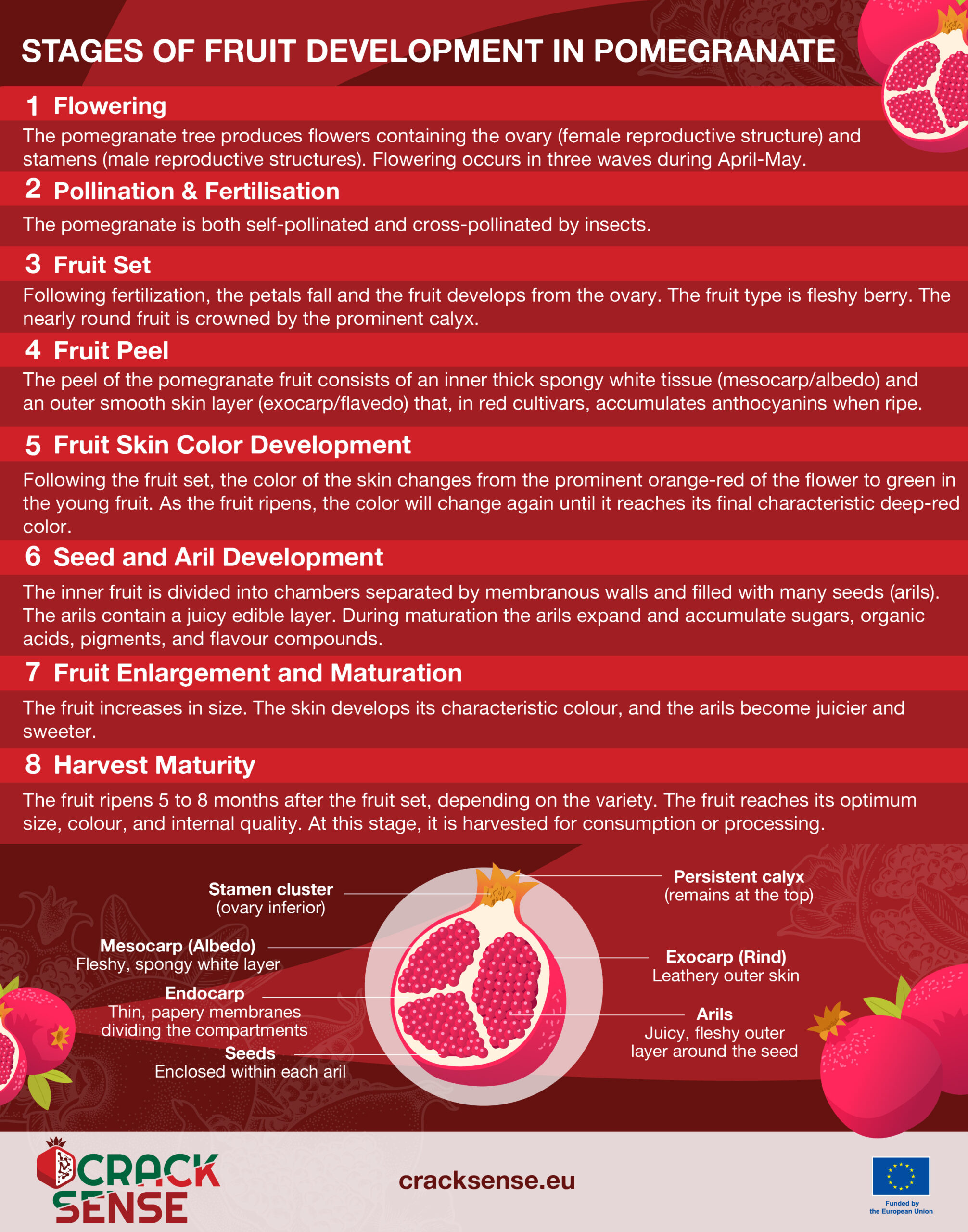
The development of a pomegranate starts with flowering. Pomegranate trees produce flowers containing the ovary, which is the female reproductive structure, and stamens, which are the male reproductive structures. Flowering occurs in three waves during April and May.
Pollination can occur within the same plant or between different plants. Pomegranates are both self pollinated and cross pollinated by insects. Following fertilisation, the petals fall and the ovary begins developing into the fruit.
The pomegranate fruit is a fleshy berry with a nearly round shape and a prominent calyx at the top. As the fruit develops, its peel forms two main layers. The inner layer is a thick, spongy white tissue, while the outer layer forms the smooth skin. In red cultivars, the outer skin gradually accumulates pigments as the fruit ripens.
Skin colour changes throughout development. After fruit set, the young fruit changes from the orange red colour of the flower to green. As maturation progresses, the skin changes colour again until it reaches the characteristic deep red associated with ripe fruit.
Inside the fruit, membranous walls divide the pomegranate into chambers containing many seeds, known as arils. The juicy edible layer surrounding the seeds develops as the fruit matures, accumulating sugars, organic acids, pigments and flavour compounds.
Throughout fruit enlargement and maturation, the pomegranate increases in size while the skin develops its characteristic colour. At the same time, the arils become juicier and sweeter.
Depending on the variety, pomegranates reach harvest maturity approximately five to eight months after fruit set. At this stage, the fruit has reached the desired size, colour and internal quality for consumption or processing.
The Mechanics of Pomegranate Cracking
The peel of the pomegranate fruit consists of an inner thick spongy white tissue (mesocarp/albedo) and an outer smooth skin layer (exocarp/flavedo) that, in red cultivars, accumulates anthocyanins when ripe. The skin is composed of epidermal cells covered by a cuticle. Pomegranate cracking and splitting occur mainly around harvest as the fruit skin ages. Because the severity of cracking varies greatly across years and locations, completely managing this phenomenon remains a complex challenge.
The most common pomegranate variety cultivated in Israel is ‘Wonderful’. It blooms in the spring, around the beginning of May, and is harvested toward the end of October. Hence, the fruit develops during the hottest months of the year. In particular, the first stage of fruit expansion, accompanied by extensive cell division, takes place during heat waves with extreme temperatures (>34°C).
These extreme conditions have the potential to substantially affect the development of the fruit, along with its skin’s structural, mechanical, and biochemical characteristics — leading to fruit cracking and splitting. Pomegranate fruit cracking may also occur when there is a lack of coordination between the increasing fruit surface area during fruit expansion and the growth rates of the rapidly expanding fleshy aril tissues, as the latter impose high tension on the peel.
What Increases the Risk of Cracking?
The causes of pomegranate cracking are not fully understood, and the severity of the problem can vary considerably between growing seasons and locations. Research conducted within CrackSense is helping to examine how environmental conditions and fruit development may influence the risk.
Contrary to what was shown for other fruit, irrigation experiments showed no effect on cracking incidence in pomegranate. Increased water amount (+20%) relative to the accepted protocol, did not result in increased cracking incidence, nor did a reduced water amount (-30%). No correlation was found between cracking incidence and water status of the tree as measured by trunk dendrometers, stem water potential and stomatal conductance. Preliminary findings indicate a correlation with mid-growth canopy size.
Research Continues to Fill the Knowledge Gaps
In parallel with the above research, ongoing efforts are aimed at early detection of the crack to better understand the causes of the phenomenon and for the purpose of predicting future yields.
Through continued field research and monitoring, CrackSense is investigating the conditions associated with pomegranate cracking and exploring ways to detect the phenomenon earlier. These efforts can support a better understanding of fruit losses and help inform future approaches to pomegranate production.
Follow CrackSense on LinkedIn for project updates and visit the Newsroom to discover more articles, insights, and research developments.