

What can pilot activities reveal about reducing fruit cracking in citrus orchards? And how can research carried out in different growing conditions help growers make better decisions? These are some of the questions being explored through the CrackSense citrus pilots in France and Israel.
Across both countries, researchers are collecting field measurements, environmental data and remote sensing observations to better understand the factors that contribute to fruit cracking. The work also supports the development and validation of machine learning models that can predict cracking risk under both experimental and commercial orchard conditions.
Together, these pilot activities provide practical evidence on how irrigation strategies, orchard variability and climatic conditions influence fruit cracking, bringing the project one step closer to reliable decision support for citrus growers.
France Pilot Activities In Citrus Orchards
Within the CrackSense project during two growing seasons (2023-2024), INRAE conducted regulated deficit irrigation experiment on citrus clementine in France (Corsica) to induce fruit cracking variability. Three irrigation treatments were implemented, each with three replicates:
- Control irrigation, managed using soil moisture sensors (capacitance probes)
- 50% deficit irrigation relative to the Control, from July to September
- 50% deficit irrigation relative to the Control, from August to September
This controlled experiment aimed to collect data from field measurements (fruit growth, stem water potential, dendrometers), fruit harvest (yield, cracking intensity) and climatic parameters to better understand how environmental conditions, physiological status and agricultural practices influence fruit cracking intensity. During field measurements, we also collect data from remote sensing by UAV (RGB, thermal, multispectral and Lidar image acquisition) to identify physiological predictors of cracking.
All these dataset have now been integrated into machine learning models to develop fruit cracking prediction models.
Preliminary results demonstrate the potential of the proposed approach. Among the tested machine learning models, ExtraTrees achieved the best predictive performance, accurately identifying trees with low and high fruit cracking levels. Feature importance analysis further revealed that climatic stress is the main driver of fruit cracking, while irrigation practices and UAV-derived tree characteristics provide complementary information that improves prediction accuracy.
Since 2025, the experiment has been extended to two citrus clementine commercial plot. The first commercial plot is located at INRAE and includes two irrigation treatment, while the second in a farmer orchard with high susceptibility to cracking. At both plot, field measurements (fruit and trunk growth, stem water potential, cracking intensity) and UAV remote sensing data are collected once per month during the fruit growing season (from July to October). These data will be used to validate fruit cracking prediction models under commercial orchards condition.
Key findings:
- Fruit cracking intensity is generally low in clementine orchards under the climatic conditions of Corsica.
- Regulated deficit irrigation appears to reduce fruit cracking intensity, although its effectiveness depends on the climatic conditions during autumn.
- Initial machine learning models have been developed to predict fruit cracking in clementines in Corsica and now need to be validated through pilot activities conducted with commercial growers.
Citrus Pilot Activities Across Israeli Orchards
The citrus pilot activities in Israel are carried out at three locations (Fig. 1A):
- Central Israel (Kfar Habad)
This pilot plot was created by combining two previous experimental plots. One experiment tested different irrigation methods, while the other tested different plant growth regulator (PGR) treatments (Fig. 1B). The treatments that gave the best reduction in fruit cracking were selected for the pilot plot (Fig. 1C):
- Standard irrigation (100%)
- Standard irrigation + auxin treatment
- Reduced irrigation (50%) during the late part of the season
- Reduced late-season irrigation + auxin treatment
- Central-Southern Israel (Nitzan)
A commercial citrus plot covering about 1 hectare (Fig. 2).
- Central-Northern Israel (Hadera)
A commercial citrus plot covering about 3.7 hectares (Fig. 3).

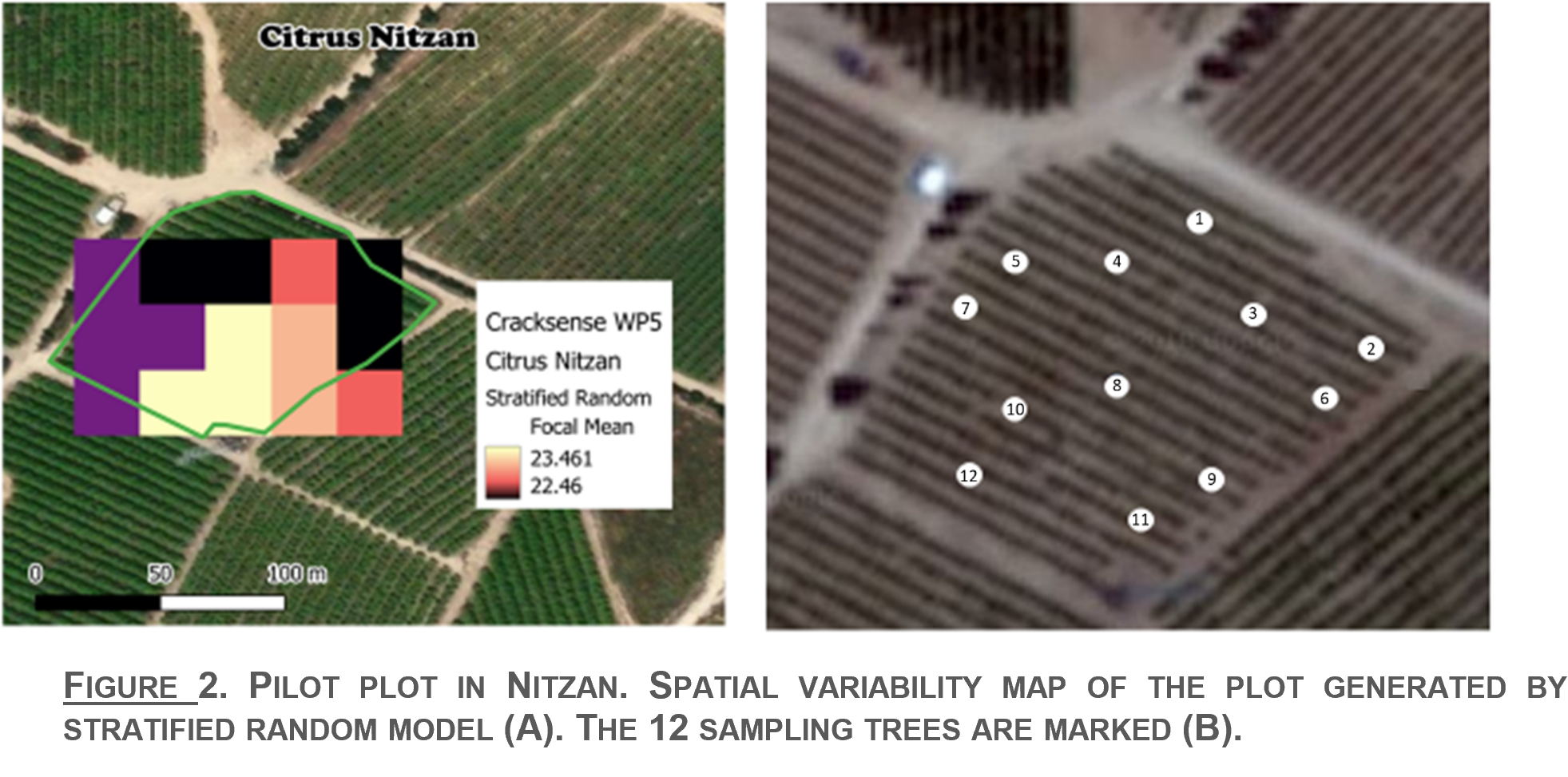
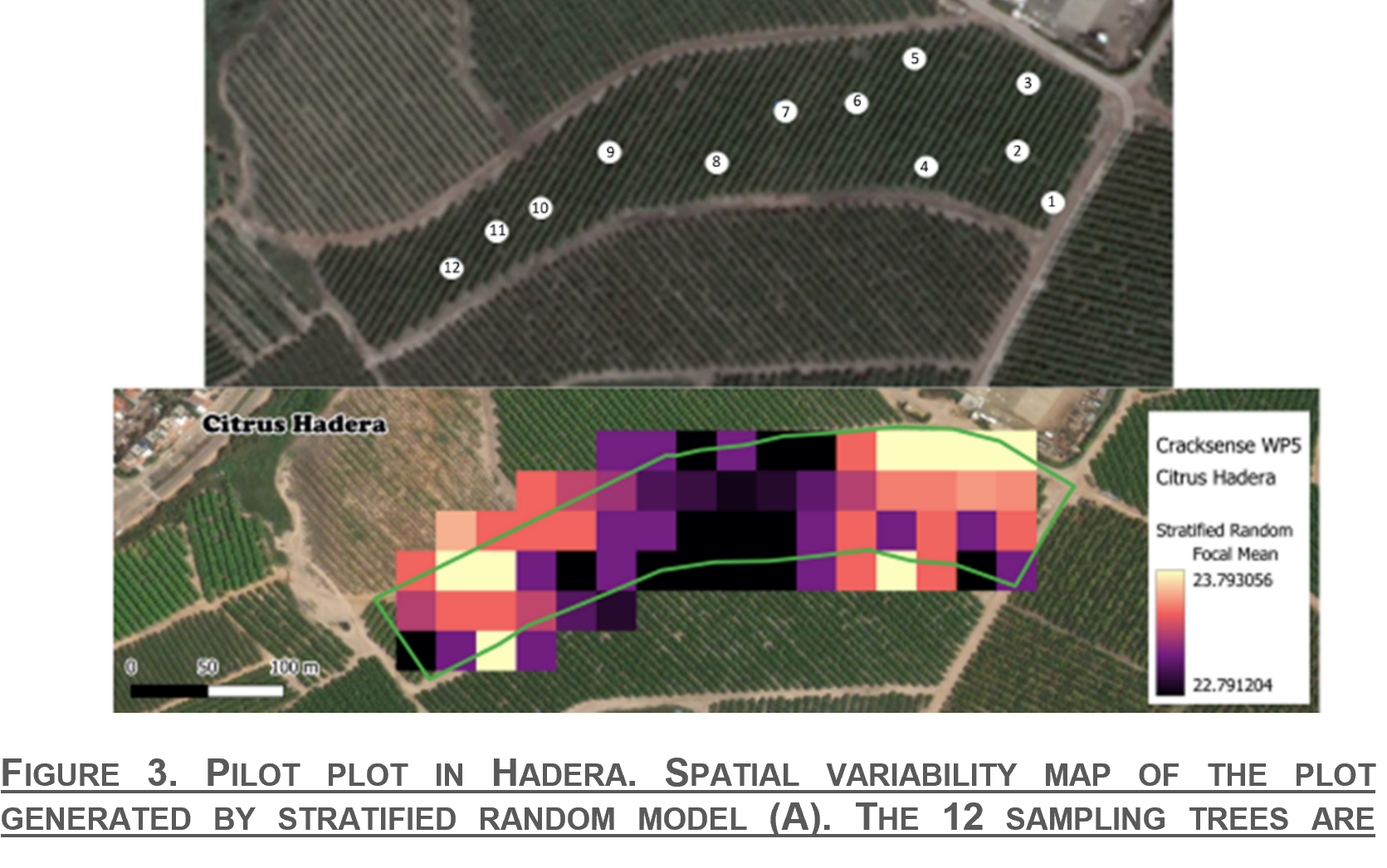
The pilot plots in Hadera and Nitzan were selected because they had a history of fruit cracking. In Kfar Habad, about 80 trees were marked for monitoring as part of the experimental design. At the Hadera and Nitzan sites, satellite images were used to identify differences within the orchards (Figs. 2A and 3A). Maps showing these differences were created using seven satellite-based parameters, including NDVI, slope, and topography. Based on these maps, 12 trees representing different areas of the orchards were selected and marked for monitoring.
Examples of results
Leaf area index (LAI) is an indicator of the amount of tree foliage. In this study, it was measured indirectly using optical sensors that estimated the amount of light passing through the tree canopy. LAI values varied between the two locations, Nitzan and Hadera, and also changed over time. The largest changes were observed during the last two measurement dates (Fig. 4).

Tables 1 and 2 summarize the yield and fruit cracking results for the monitored trees in Hadera and Nitzan, respectively. Trees in Nitzan produced a much higher yield than those in Hadera. However, fruit cracking was also more severe in Nitzan, ranging from 32% to 61%, compared with 9% to 34% in Hadera.
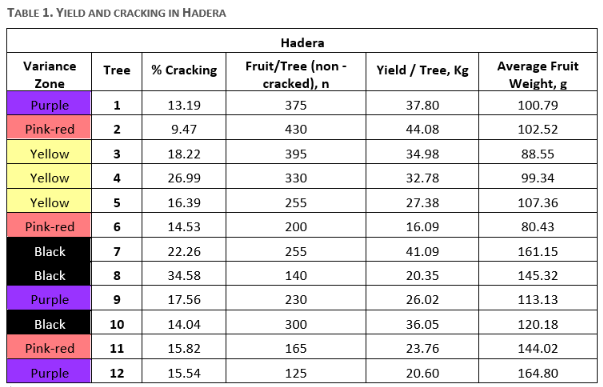

Overall, the pilot plots provided a wide range of natural variation in yield and fruit cracking, both within and between orchards, without the need for additional experimental treatments. This variation was essential for validating the yield and fruit cracking prediction models developed during the first phase of the CrackSense project.
Bringing the Findings Together
The citrus pilot activities in France and Israel demonstrate the importance of testing prediction models across different environments, orchard types and management practices. Together, these activities are improving the understanding of fruit cracking and supporting the development of prediction tools that can help growers respond to changing conditions with greater confidence.
Follow CrackSense on LinkedIn for the latest project updates, and visit the Newsroom to read more about our pilot activities, research progress and project results.