
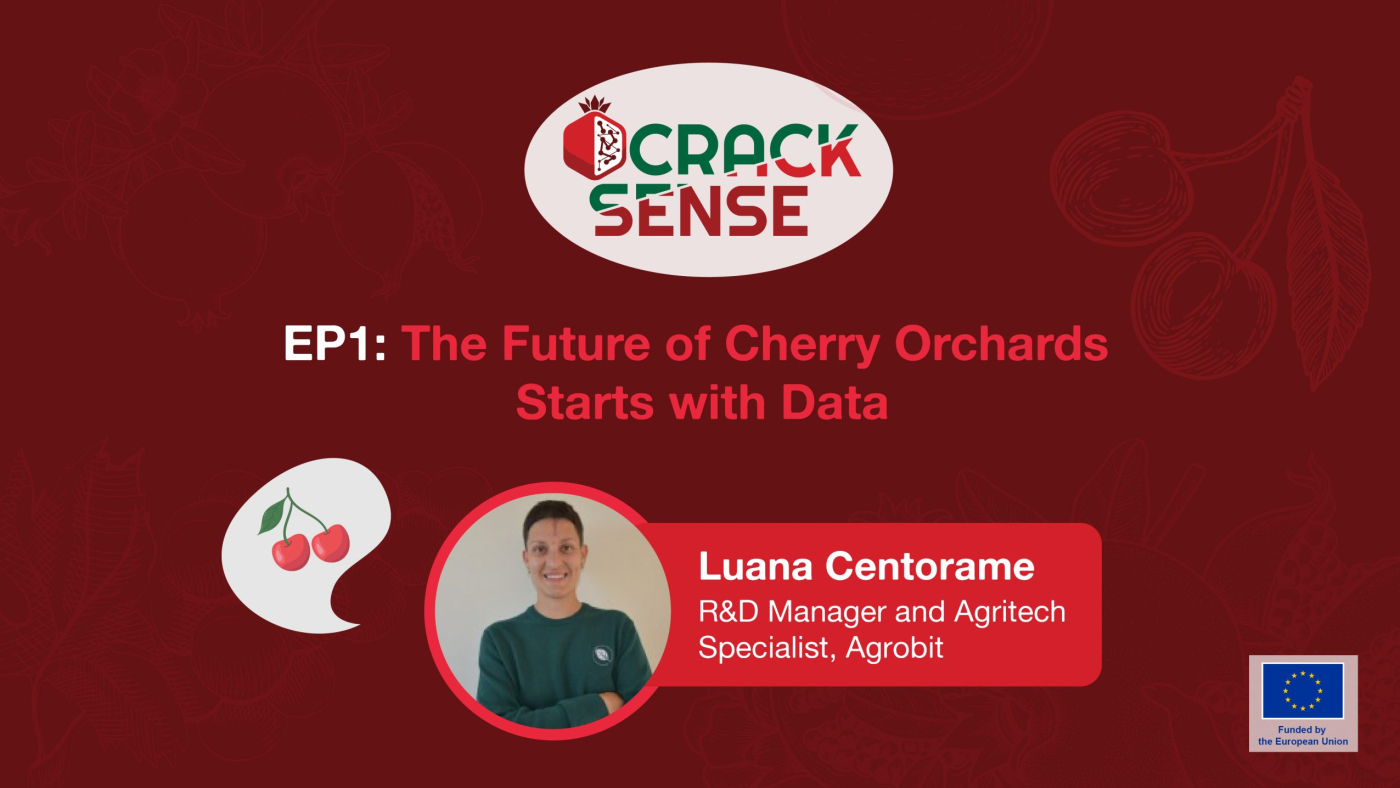
The CrackSense project’s Data Stories 360° series explores how data and technology are transforming agriculture in practice. In this feature, the focus turns to cherry orchards and the growing role of digital tools in supporting farmers’ decisions.
Insights are shared by Luana Centorame, R&D Manager and Agritech Specialist at Agrobit, whose work sits at the intersection of precision agriculture, artificial intelligence, and real-world farming challenges. Together, these perspectives show how digital tools are improving cherry production, with a focus on efficiency, sustainability, and risk management in real conditions.
Exploring Our Guest's Professional Journey
Could you tell us a bit more about your professional journey so far, the kind of work you are involved in today, and what first motivated you to move into digital agriculture?
My name is Luana Centorame. I am an agronomist and soon to be a PhD in agricultural sciences. My journey into digital agriculture started at university, where I first began experimenting with approaches to precision agriculture, initially during wheat harvesting in central Italy, and then using a smart sprayer in vineyards. I had the opportunity to pursue a PhD in agricultural engineering, focusing on the application of AI to drone-based image analysis. Today, I work as an R&D manager and Agritech Specialist at Agrobit, where I am involved in the development of a mobile application and in applying AI and computer vision to the analysis of drone imagery.
Challenges and Opportunities in Cherry Orchards
Cherry production is still often managed through experience-based and manual practices. From your perspective, what are the main limitations of this approach today?
I think that experience-based agriculture is still extremely widespread and deeply rooted, even more so in cherry production, which is a relatively niche sector. From my perspective, one of the main limitations of this approach is that it strongly hinders generational turnover, because a great deal of valuable knowledge that is in farmers’ hands risks being lost rather than transferred or formalised. For example, building a historical dataset is one of the key factors of digital agriculture.
Another critical aspect is labour cost. Relying heavily on manual practices makes the final product, for example sweet cherries, less competitive on the market. Lastly, I think that this approach tends to account only to a limited extent for spatial and temporal variability in the field. Today, this is a pivotal factor for improving efficiency, sustainability, and also decision-making for farmers.
Smart Tools and Future Outlook for Orchard Management
Within the OpenAgri project, you are involved in SIP 10 and the development of SmartCherry. For listeners who are not familiar with OpenAgri or the SIP structure, how would you describe SIP 10 and the core idea behind SmartCherry in simple terms?
SIP 10 is SmartCherry, which addresses the lack of affordable and crop-specific digital tools for cherry growers. More specifically, in protected geographical indication contexts, such as the Cherry of Lari in Tuscany, Italy, farmers must meet strict quality, traceability, and sustainability standards while facing limited connectivity or economic constraints that prevent them from adopting costly digital tools designed for larger crops like cereals or vineyards.
To bridge this gap, SmartCherry introduces a smartphone-based decision support system tailored specifically for cherry growers. It empowers them with data-driven insights on irrigation, fertilisation, and pest management without requiring expensive hardware or continuous internet access.
SmartCherry turns a smartphone into a decision-support tool using 3D scanning, AI, and both edge and cloud processing. What were the key design choices you made to ensure the system works in real orchard conditions, especially for farmers with limited connectivity or resources?
SmartCherry was specifically designed as a local solution built around an existing mobile application. I think there are three main design choices we made.
The first was to rely entirely on the smartphone, making the system accessible to everyone, as nowadays almost everyone has one. It does not require dedicated infrastructure, complex machinery, or additional hardware.
The second key decision was to ensure that the app works well even in poor connectivity conditions, which are very common in rural areas. Farmers can carry out image acquisition and the first steps of analysis even without an internet connection.
Last but not least, another crucial aspect was bringing together several essential functionalities, such as weather forecasts, canopy and digital twin analysis linked to vigour and water stress maps, alert systems for diseases and pests, and reporting tools. This integrated approach helps farmers make informed decisions using an all-in-one solution through their smartphone.
CrackSense focuses on fruit cracking risk through multi-scale sensing, environmental data, and decision support systems, including work on sweet cherries. From your own experience working with cherry growers, how visible is this problem in practice, and how do farmers currently try to manage or anticipate it?
From my experience working with cherry growers, fruit cracking is a very visible and well-known problem, especially in the days leading up to harvest and after sudden rainfall events. In Italy, for example, farmers are fully aware of the risk and still manage it using a combination of choosing tolerant varieties and careful irrigation to avoid water stress. There are also other solutions, such as rain covers, but they are still costly for small and medium-sized farms.
Overall, many decisions, such as anticipating harvest or adjusting management practices, are still made based on experience-based agriculture. What is often missing is a data-driven approach that can quantify cracking risk in real time by combining environmental conditions, development stage, and orchard variability. This is exactly where systems like those developed by CrackSense can make a real difference.
Both OpenAgri and CrackSense use precision-farming approaches, data-driven decision support, and advanced sensing technologies, but they focus on different outcomes. How do you see these two approaches complementing each other when it comes to improving orchard management and decision-making?
I think that OpenAgri and CrackSense are highly complementary rather than overlapping approaches. They both rely on precision farming, but they focus on different, interconnected levels of orchard management.
OpenAgri focuses more on the structural and physiological understanding of the orchard. For example, monitoring canopy development, vigour, stress, and spatial variability over time. This type of data supports strategic and operational decisions, such as input management and long-term optimisation.
On the other hand, CrackSense focuses on a very specific but economically important risk, which is fruit cracking, by combining multiscale sensing with environmental and weather-driven data. When combined, these two approaches create a more complete decision support framework. The orchard-level insights provided by OpenAgri can supply baseline conditions and variability context, while CrackSense can build on this information to deliver targeted risk assessments and timely actions.
Looking ahead, how do you see orchard management evolving in the next few years?
I see orchard management becoming increasingly data-driven and predictive rather than reactive. That is the biggest difference between experience-based agriculture, which reacts to problems, and digital agriculture solutions, which predict them. For example, predicting the risk of Monilia in cherries over the next five days.
In the coming years, we will move away from isolated tools towards systems that combine multi-layer data, such as environmental data, plant physiology, canopy-level and field-level variability, into a single decision-making framework. Artificial intelligence will play a growing role because it translates complex data into actionable insights for farmers.
At the same time, smartphones and local sensing technologies will continue to lower the barrier to adoption, which is one of the biggest bottlenecks in digital agriculture. Smartphones will make digital agriculture more accessible, even for small and medium-sized farms.
Another key shift will be the focus on risk management due to extreme climate events and pest and disease outbreaks, supported by early warning systems and predictive models.
I think that orchard management will evolve towards more resilient systems.
Conclusion
We thank Luana Centorame for sharing her valuable insights and practical experience from the field. Her perspective highlights both the challenges and the opportunities that digital solutions bring to orchard management.
To stay updated on CrackSense activities and explore more stories like this, follow us on LinkedIn and visit our Newsroom for the latest project updates.